The Baptism Site is rediscovered
Many centuries later, in 1995, a Franciscan archaeologist, Father Michele Piccirillo, identified an area which he considered most likely to be the place of Bethany beyond the Jordan. He had studied the map of Madaba, and taken into account the writings of early Christian pilgrims, the traditions of the Orthodox Church and the local place names, Unfortunately the area he identified was under a minefield.
Father Piccirillo approached Prince Ghazi, a nephew of the late King Hussein and cousin of the actual King Abdullah II, and presented his case. After some initial visits and findings the Prince was convinced and sought permission from King Hussein to excavate the area. King Hussein had just signed a peace treaty and gave permission for de-mining to commence so the excavations could start. The excavations brought to light much more than had been hoped for.
Their findings
The archaeologists found the remains of a large thriving Christian community and place of pilgrimage. They uncovered numerous churches and monasteries, wells, water cisterns, caravan inns, mosaic floors and hermit caves.
They identified Elijah’s Hill , the remains of a church containing the cave of John the Baptist, and, more importantly, John the Baptist’s Spring and the ancient course of the river Jordan.
Where the last two met the most important discoveries were found. Where the river once ran the remains of 5 important churches including four stone vaults spanning the river were discovered.
These discoveries all tied in with the accounts we have from pilgrims who visited the Baptism Site in the early centuries of Christianity.
The findings caused great excitement and much discussion in religious and historical circles throughout the world. It was obvious to all that this was no ordinary site. There must have been something very important going on here for such a large pilgrimage site to have been built in what is largely a desert area.
The experts all agree
Eventually
- having studied the archaeology that had been uncovered,
- read the detailed descriptions left to us by the early pilgrims,
- compared the location in the ground to that shown on the Map of Madaba and
- analysed the local names given to these place,
it was agreed that this Bethany beyond the Jordan is, in fact, the true site of where Jesus was baptised.
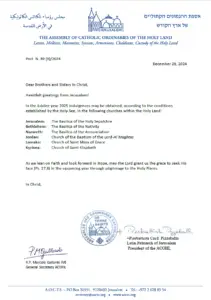
Once the conclusions were made public things began to move quickly. All of the major Christian denominations sent Letters of Authentication to the Baptism Site Commission confirming that they recognised this to be the Baptism Site. Then many influential pilgrims came to pray at the site and give their support. The last 3 Popes, John Paul II, Bendict and Francis, all came to pray at the Baptism Site. King Charles and Queen Camilla came to pray at the site and many other world leaders.
UNESCO World Heritage Site

The Baptism Site is important for many reasons and it holds special Importance not only for Christians but also for Muslims who revere both John and Jesus as Prophets.
Understanding the importance of the Baptism Site the Late King Hussein gave clear instructions.
“Heritage belongs to humanity. Take good care of it. Help us preserve it.”
The Baptism Site Commission has worked to maintain and preserve not only the archaeology but also the ecosystem of the wilderness where John lived and preached. These efforts have been applauded by UNESCO. In 2015 the Baptism Site was awarded UNESCO World Heritage Status.
Pilgrim Trail Guide

Holy Year Indulgence
Heritage Site